
When a person dies without a valid will or trust in California, their assets are distributed to surviving relatives. This is done using a process called “intestate succession.” The state essentially has a prescribed hierarchy of who gets what. Oftentimes, the process produces results that were never intended and can create a lot of heartache and stress for your loved ones after you die.
Under California law, the estate is generally distributed first to the surviving spouse and children, then to parents, siblings, and more distant relatives if necessary. What California intestate succession law does not do, is take into consideration your personal preferences or family dynamics. For instance, that parent that you went no-contact with 5 years ago? They could end up with some or all of your belongings. The spouse you separated from but didn’t get around to divorcing quite yet? They could end up with ½ of your estate.
The good news is, if you are reading this, you still have time to course-correct and insure that your wishes are known and followed.
How Assets are distributed without a will
Our California intestate succession chart can help visualize how the Court will distribute your assets.
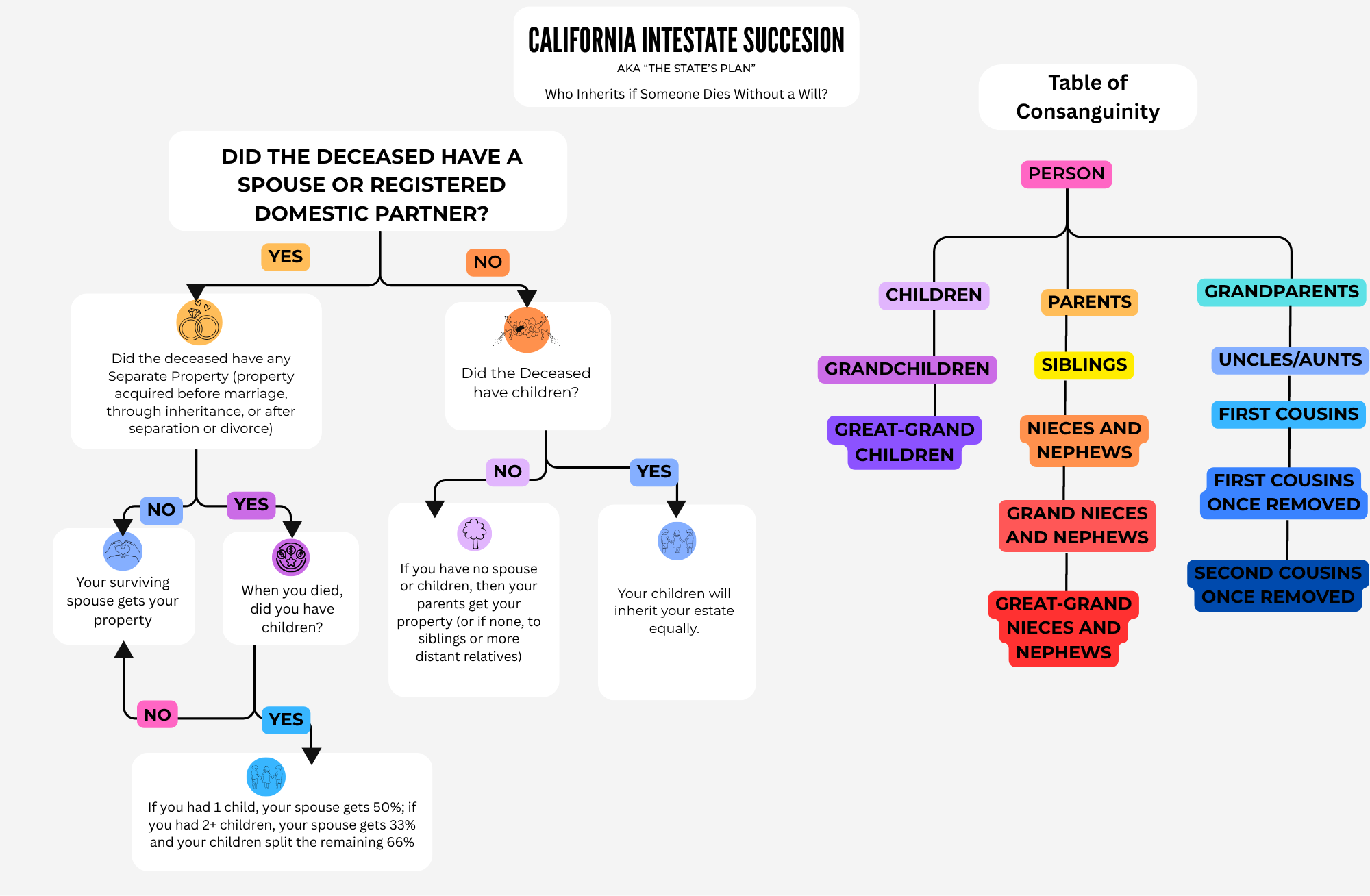
California Intestate Succession and Table of Consanguinity
A few key things worth noting:
Adopted children count the same as biological children; stepchildren generally don't unless a legal relationship exists (which is uncommon).
Children from a first marriage would be forced to split their inheritance with a step-parent.
Step-children may be completely cut out of the inheritance, even when they were part of the family for decades.
Half-siblings inherit the same as full siblings under California law.
California is a community property state, which is why that split matters so much — separate property (owned before marriage, or received individually via gift/inheritance) follows very different rules than property acquired during the marriage.
Only the decedent’s assets will pass in this way; meaning that if the person was married, only their ½ of the assets will pass to their heirs. The surviving spouse will retain their own interest in property.
California Probate Code, Section 6400-6414 dictates exactly how the property is distributed.
What you can do to ensure the people you want to inherit are provided for
The best way to ensure that your assets are distributed the way that you want is to create a comprehensive estate plan that will clearly lay out who you want to inherit your estate and what you want them to receive. With a comprehensive estate plan, you can include friends, step-siblings or step-children. You can also exclude anyone that you want- be it your spouse, parent, child, etc.
STILL HAVE QUESTIONS?
Intestate succession is one of the most common ways assets are transferred after death when there is no estate plan. While the process can be straightforward, it can become quite complex.
If you have questions about how to avoid intestate succession, and how to ensure your legacy and your assets are distributed the way that you want, contact us. We are here to help!